|
|
|||||
DYNAMIC EQUILIBRIUM
|
|||||
|
|
|||||
|
The
precision
forward, and
the proper stance or posture while moving backward allows the player to
change direction at any given moment while going into, or out of the court's corners. Loss of dynamic equilibrium would impede
the player from doing so. Even when the player stops into position and hits
the ball, he is never still. There is always some part of his body moving.
Hence, our great interest in dynamic, rather than static balance. In some
cases, while a player is executing a shot and his legs seem perfectly still,
it may seem that all he has to do is hold that static position while he hits
the ball. Such reasoning is not realistic, as it does not take into account
the movement of the player’s arms and shoulders. Therefore, some degree of
weight transfer does occur and the player must learn to both counterbalance,
and make use of these forces. However, most important of all, his muscle
fibres must become sensitive enough to detect variations and respond accordingly.
The muscle fibres can twitch and adjust; thanks to our body's built in
sensors which fire impulses back and forth. Dynamic balance could be best
understood as the management of unstable equilibrium. A finely tuned nervous
system, which reacts at subconscious level, permits top sportsmen the ability
to control movement. However, technique, co-ordination and posture are
cultivated also consciously to achieve improvement. Posture is important
because a well-positioned centre of gravity is the key to efficient movement.
|
|||||
|
|
|||||
|
Moving
slowly to an easy ball may render the task fairly simple. But, what happens
when the striker is coming in at full speed and has to hit the ball very
hard? The notion of dynamic equilibrium becomes very important. In this case,
the forces involved are huge and the athlete’s muscles and nervous system
must be finely tuned to cope adequately. Also, a player must strive to have a
low centre of gravity. Without a low centre of gravity, maintaining balance
would become almost impossible and the muscular exertion would be immense. |
|||||
|
|
|||||
|
Any
aspiring player will have noticed the difficulty of making a good return when
the opponent’s shot is clinging to the sidewall. The problem is compounded
when the retriever has to move fast before actually reaching the ball.
Without good dynamic balance, at worse the racket will end up in the changing
room bin. At best, the player will mishit the ball. There is no point in
being the fastest on a squash court when every tight drop shot is retrieved into
the middle of the court or results in a stroke awarded. Being fit and fast is
only rewarding when the quality of retrieving permits the player to regain
some control of the T. |
|||||
|
|
|||||
|
defined, tested, and improved in academic terms? This refers us to the work done by Prof. Dario
Riva, Director of the department of research at the Scuola Universitaria
Interfacolta` in Scienze Motorie di Torino. |
|||||
|
|
|||||
|
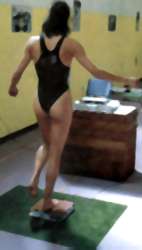
Subjects
are tested on a single axis balance board equipped with sensors. The sensors are
capable of graphing the inclination of the board. The graphs are updated
constantly with no time lag on a screen in front of the subject. The visual
feedback permits the subject to make a much greater number of adjustments per
second compared to the same conditions without the graphs. The task may
become easier but the benefits are much greater with visual feedback. The
greater number of subconscious adjustment processed by the archaic part of
the brain provide the greatest benefits in terms of unstable equilibrium
management. |
|
|
|
Photo
courtesy of Delos
International |
|
|
|
|||||
|
There
are three distinct methods for "regaining equilibrium". (Regaining
equilibrium is stated as opposed to "maintaining equilibrium". This
is more accurate, as conditions are always changing as the balance board
oscillates. "Maintaining equilibrium" may be misinterpreted and
thought to imply static conditions. As we are discussing unstable equilibrium
management, referring to constant adjustments to regain equilibrium renders
the concept clearer. Note that in most cases, a good athlete will make micro
adjustments that may make the position seem static. In reality it is dynamic
and changing.) a) The use of the arms
to counterbalance the board's inclinations, b) the use of the upper body and
hips to readjust the body's centre of gravity, and finally, c) the use of the
leg joints to adapt. This final method is the most refined and precise of the
three, and used by top sportsmen. The nervous system and its interaction with
the muscle cells, to twitch, adjust, and reposition the joints, all occurs at
a local level without conscious intervention by the brain. The adjustments
are also minimal, but most frequent, permitting the subject to maintain the
original posture. Hence, rendering it the most refined management
system. |
|||||
|
|
|||||
|
In
order to achieve the most amount of neuro-motor stimulation in the legs for
optimal unstable equilibrium management, the subject is instructed to place
the hands onto his hips to exclude the use of the arms as a balancing agent.
A sensor is placed on the spine, just below the neck. This sensor gives
instant graphic feedback on the screen in front of the subject. The graphs
indicate any sideways inclinations by the truck. The subject must try to
eliminate such compensation. That is, use of the upper body and hips should
be excluded in order to rely on the lower limb as the sole management system
working together with the visual feedback.
|
|||||
|
|
|||||
|
This
is just a brief summary of professor Riva's work. The professor's work also
explains and tests the benefits of combining dynamic equilibrium exercises
with weight training to achieve greater gains. More information could be
found at www.ilfisioterapista.it
|
|||||
|
|
|||||
|
moving and the court
floor is stable, parallels could be drawn and useful insight is gained. The
work carried out in the laboratory confirms: |
|||||
|
|
|||||
|
a)
The importance of posture
and a correctly positioned centre of gravity. For example, try staying on the
board while constantly leaning to one side or backward. The task becomes
almost impossible. Compare this to correct posture, which must be maintained
during acceleration off the T, entry and exit into the corners. |
|||||
|
|
|||||
|
b)
The interaction between
agonist and antagonist muscles. Opposing muscles and muscle groups together
with stabiliser muscles work to manage balance and posture. If the
interaction is excessive while a player is on court, fluid movement is
hampered. Hence, the importance of relaxation. The system must be finely
tuned so that only the least indispensable muscle fibres must work to manage
balance, while only the interested specialised muscles must work to propel
the player into the desired direction. |
|||||
|
|
|||||
|
c)
Unstable equilibrium
management can be achieved with great energy expenditure (if the arms, upper
body, and hips are utilised), or with minimal effort if management is finely
tuned and limited to the legs in association with correct posture and useful
visual feedback. |
|||||
|
|
|||||
|
d)
During a situation of unstable
equilibrium, a far greater number of nerve impulses are firing and
interacting with the leg muscles for prompt readjustment, than during a
situation of static balance. This infers that remaining on the heals of both
feet with legs well bent produces a position that is too static and
unfavourable for reflex reactions off the T. |
|||||
|
|
|||||
|
e)
Finally, but probably most important of all. Dynamic balance management
through local
interaction between nerve and muscle fibres with the exclusion of our
conscious thought process, underlines the importance of training to render a
movement or stance automatic. Our sensory system works in collaboration with
the most antique part of the brain. It is as if our muscles have a brain of
their own. Hence, the importance of repeating an action and adopting learning
techniques which permit the muscles to "feel" and
"understand" what they are doing. Relate this to the advice given
to coaches and players in the sections on technique and movement. |
|||||
|
|
|||||
|
The
section on training is full of exercises to improve fitness and court
movement. If you would like to see those devised to improve specific dynamic
balance, click
here. |
|||||
|
|
|||||
|
|
|||||
CHANGING DIRECTION
|
|||||
|
|
|||||
|
Squash
is a fantastic game, full of tactics and
trickery. Prompt reflexes will help a player survive. However, when it comes
to changing direction, no amount of reflexes and power combined can
substitute correct posture and balance. Directional change in this game is
constant and very abrupt. A clever squash player must smoothen the harshness
inherent to this game in order to reduce the effort required to chase the
ball around the court. |
|||||
|
|
|||||
|
In
the sections above, the correct stance during each moment of every imaginable
situation has been scrutinised. This small section will demonstrate that
dynamic balance and the awareness of its importance at all times, is a key
factor, in securing adequate court coverage. In other words, the player must
manage his body weight and inertia through correct posture and co-ordination.
|
|||||
|
|
|||||
|
When
playing an easy rally at a comfortable pace, each player is subject to
directional changes. He/she may start off from the T, move forward to one of
the corners, stop, then return back to the middle. On returning to the
middle, he/she may pause for a fraction of a second, or immediately change
direction and set off to a different corner. This type of directional change
is the most simple, and is continuous during a match. When a player has a
clear idea of where he/she should go, everything is smooth. The problem may
arise when the pace of play is very high against an opponent who is clever at
disguising his shots, or often uses deception with good skills. |
|||||
|
|
|||||
|
Under
such conditions, a player may start off in the direction of one corner, then
suddenly have to adapt and change path towards another. In other words, the
player must be able to cope after being slightly wrong-footed. At this point,
it is important to realise that a player may go through a mental change of
direction, too. That is, he may initially, for a fraction of a second,
erroneously believe that the ball will end up in one corner, before
understanding that it will bounce into another. An experienced player may
often make such changes without committing himself in any particular
direction until he/she has a clear vision of where he should be heading.
Hence, the term, mental change of direction. |
|||||
|
|
|||||
|
In
order to cope best in any of the situations described above, there are two
rules to follow. The first regards body posture. The player must always
incline the upper body slightly forward. This is most important, either when
the player is standing on the T, or in motion around the court. At no moment
in time should the upper body be allowed to rock backwards or lose this
correct posture. The second rule is to be quick at taking the racket back and
turning the shoulders. Even when wrong-footed, a player should recover
towards the correct direction by first taking the racket back towards the
side to which he/she intends to move. |
|||||
|
|
|||||
|
In
this example, the player believes to be on the receiving end of a shot in the
rear backhand corner, before realising that he should move into the rear
forehand side. Despite misreading the situation at first, he is hardly
affected. His quick reflexes with the hand, and the delayed action of the
feet, save him from stepping into the wrong direction. |
|
|
|
||
|
|
|||||
|
|
|
|
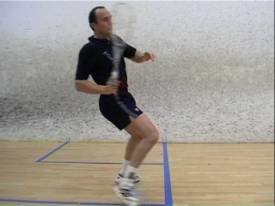
In
this exercise, the trainer or coach is standing at the front of the court,
giving indication towards one direction, then to another just after the
player begins to move. In the first example, the player makes the mistake of
leaning backwards to move to the rear. |
||
|
|
|||||
|
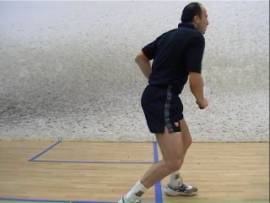
The
following is an example of an initial forward movement, which is then
changed, and the player goes to the back. Again, the incorrect position of the upper body, slows down the
player, Leaning
back to move backwards may seem like a good idea, but what would happen if a player
has to suddenly change direction to |
|
|
|
||
|
go
forward? |
|||||
|
|
|||||
|
Another
most significant disadvantage of leaning backwards or even to the side, is
that an eventual counter reaction is produced. The result is loss of upper
body control and an excessive rocking motion every time the player stops and
turns. |
|||||
|
|
|||||
|
|
|
|
|
||
|
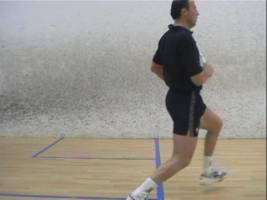
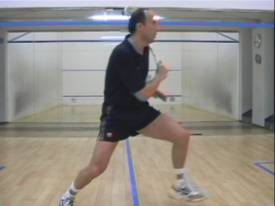
The
player is seen here, pushing off towards the backhand side. The correct
position of the trunk harnesses the push developed by the player’s right leg. |
|
|
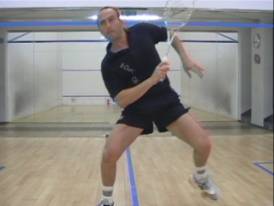
In
this case, however, the player is leaning backwards, and the right leg pushes
only the hips towards the left side of the court. A great deal of energy is
wasted, and the player would not be in a position to play an immediate shot
on the backhand. |
||
|
|
|||||
RETURN TO INDEX GO TO NEXT
SECTION