|
|
|||
|
Never change |
|||
|
|
|||
|
For many years, this has been
repeated as an affirmation, and not as a question. So why the question mark? |
|||
|
|
|||
|
A winning game is a rather
subjective matter. A winning tactical scheme may work well, but will probably
not work forever. As the pattern is repeated, and the opponent understands
the player’s intentions, conditions change. The opponent will probably become
more competent at making the right response. He will also have a game plan of
his own to disrupt that of the player. Therefore, a smart player will change
a “winning game” when he senses it being less effective. He should have
alternate plans ready, and understand why this new playing pattern will work.
When he attains success with this second pattern, he could switch back to the
original plan. This would again catch the opposition by surprise. If he is
capable, a third scheme could be used later to keep the rival on the
defensive. The important point to
make is, never change just for the sake of change, or adopt other strategies
without knowing the specific outcome. |
|||
|
|
|||
|
A match is never over until the last point has
ended and you shake hands. |
|||
|
|
|||
|
You would do believe this without having to learn
it the hard way. An incredible amount of matches are won after a player
trails behind and is perhaps two games down and one point away from defeat.
On the other hand, an endless number of matches have been lost despite having
gained match point. These are facts. Keep them in mind when thinking tactics. I have often come across
players who make a slip of the tongue, and say things like, “I won the first
game 8/2”. Amazing, but a sentence like that really does say so much. The
vast majority of players really think that they have won when they arrive at
8. Do not make this mistake. When you get to 8 in every game, concentrate and
fight harder. |
|||
|
|
|||
|
When
to speed |
|||
|
|
|||
|
Increasing the pace of a
rally could be carried out for a few seconds or for the whole of its
duration. When the pace has been increased for several consecutive rallies,
then the pace of the game has risen. You should try to pick up the pace to
see if you could allow your opponent less time to react. (Make sure you have
seen the section on time interval between shots.) Therefore,
you should; |
|||
|
|
|||
|
Increase the pace whenever
your opponent shows signs of inability to adapt. These include, loss of
precision, fatigue, disturbed tactical choices, impatience and increase in
errors. |
|||
|
|
|||
|
Increase the pace as an
alternative to slow spells. The change could upset the opponent’s rhythm and
plans. |
|||
|
|
|||
|
Increase the pace when you
find that you are able to speed up the rallies without losing valuable
precision, you may continue to do so, if the physical effort you make to
attack, is less than that made by the opponent to retrieve and defend. |
|||
|
|
|||
|
Speed up the pace and
maintain accuracy, after you have had a hard rally or a series of hard
rallies in which your rival has suffered more. |
|||
|
|
|||
|
Increase the pace in order to
keep your opponent on the move at a constant rhythm with little time to think
and position himself ideally. This is the perfect environment for holding
certain shots and using deception. The sudden change of timing and direction
will prove to be most effective. |
|||
|
|
|||
|
A player who has a good boast
should often raise the pace of a rally just to insert that particular shot. A
quick and accurate boast played within the context of a fast rally is ideal
to make the opponent stop, start, change direction and stretch. This is the
kind of movement that will tire the opponent and wear him down. Such
treatment may well cause the opponent tactical problems and keep him on the
defensive. |
|||
|
|
|||
|
Short . |
|||
|
|
|||
|
Short-term tactics involve
the choice of shot to be made at the moment, and the construction of the
rally. Many of the concepts explained above involve short-term decisions.
Short-term tactics will often be adopted, knowing that their real value shall
be evident later on. Long-term tactics could be viewed as the scenario which
a player wishes to achieve at a latter stage of the match. |
|||
|
|
|||
|
In
a hard, well-balanced match, sound short-term choices may seem ineffective
until the match reaches an advanced stage. On the other hand, if poor
short-term tactical play is created, its disappointing outcome is soon
evident. Time
intervals between shots, and crossing paths, for
example, can be identified as short-term tactics. Long-term tactics are seen
when a player sticks to a game pattern for a relatively long time, and makes
changes only when he has achieved his objective. |
|||
|
|
|||
|
Very gifted players have
often adopted a clear example of one type of long-term tactic, during
relatively easy matches in the first round or two of a tournament. An
incredible demonstration of skill and deception leaves the opponent puzzled
and unable to read the game. Having made the opponent run around, and
rendered slower, such players would take further advantage of the loose shots
that come their way. The opponent loses all confidence and is unable to
defend. Keen viewers will have seen players like Qamar Zaman, Rodney Martin,
and lately Jonathan Power, do so, time and time again. |
|||
|
|
|||
|
A more common tactic seen
practised by great champions such as Geoff Hunt, Jahanghir Khan, Jansher Khan,
and lately, Peter Nicole, is the long tough first game. After a hard game 30
minutes or more, the opponent breaks down physically and mentally. The
message put across from the beginning is “you will have to fight me like this
for two and a half hours if I’m going to be beaten.” Usually the second and
third games last far less. |
|||
|
|
|||
|
This long-term tactic may
have its effect at the end of every game. A player may keep the rallies long
and hard for the first 20 minutes of each game. During these 20 minutes, the
opponent is made to work hard, and is given very few opportunities to attack.
The opponent’s heart rate is made to build up to uncomfortable levels. The
player would then go into the phase of increasing the pace, for an all out
attack during the last few points. At this point, the opponent no longer
believes in being able to invert the situation. The pressure has been
consistent and overwhelming. |
|||
|
|
|||
|
To construct effective
long-term tactics, a player must have a great deal of discipline. He must
know the fundamentals, and stick to them. When making short-term tactical
choices, he must have a vision of where they fit in, and how they relate to
the global picture of long-term objectives. If you would like to know more,
or have any questions regarding this subject, e-mail me at hesham@shotsquash.com |
|||
|
|
|||
|
|
|||
|
|
|||
|
Winning
the important points. |
|||
|
|
|||
|
, but
some are really decisive. The big points are what make the difference between
winning and losing. However, that does not imply
that only the final points of a game or match are important. |
|||
|
|
|||
|
-At the start of a match for
example, a player may be nervous and have some breathing problems. He should
try to relax and think that his opponent is probably feeling just the same.
Instead of worrying about himself, he should try to make his rivals breathing
problems even greater, by making him work hard. |
|||
|
|
|||
|
-The first points of a match
may well determine which player is able to create a pattern and dominate. The
start of a match is also a confidence builder or breaker. Therefore, accurate
preparation is vital. |
|||
|
|
|||
|
-Take advantage of patches
where an opponent’s confidence sags. Be even tougher and drive through his
weakness. |
|||
|
|
|||
|
-Take advantage of error
streams. You will often find that at times, an opponent will make one error
after the other. Do not be drawn into allowing yourself a breather and
relaxing, or the luxury of trying your luck with risky shots. |
|||
|
|
|||
|
-When the opponent gets angry
with himself, be very careful, it can be contagious. Keep focused and take
maximum advantage of his negative attitude. |
|||
|
|
|||
|
-Needless to say, points
towards the end of a game or match are most important. Try to confront them
by focusing so hard on the game plan and what you should do, as to completely
forget the score. There is no sense in thinking “I need just one more point.”
Think how you should play the rally instead. |
|||
|
|
|||
|
-Never relax when you are way
ahead on points and near match ball. Tons of matches have been lost when
almost won. Remember that your opponent will probably fight for his life at
that stage. He cannot afford to let go. If you do not put in your best
effort, you may see the gap narrow down dramatically. This could ruin your
concentration and affect your performance, leading to more points lost.
Before you know, it could be the game or match lost. |
|||
|
|
|||
|
-After a hard long game,
which you have snatched from your opponent, take further advantage. After the
break, he may be still regretting his loss and not regain his concentration
and determination. Come out with a punishing attitude and take the opening
points. Put yourself on track to a new lead. |
|||
|
|
|||
|
-Make the most possible
effort to win the longest, most punishing rallies. Taking these points will
make you feel good and give you a great psychological and physical boost. The
looser will feel much more tired. |
|||
|
|
|||
|
-Strive to win the rally,
which follows an exceptionally tough one. This is the moment to prove many
things, and send the message through. You will be saying that you are tougher
and determined not give away any presents. This is your chance to break the
adversary. If the opponent does not produce a fight, remain determined and
wait to win the next hard rally as soon as it arrives. |
|||
|
|
|||
|
|
|||
|
When |
|||
|
|
|||
|
In the section on deception,
a comprehensive explanation provides an answer to this question. A clear
statement is made on the use and overuse of deceptive tactics, the effects of
misleading the opponent, and the importance of demonstrating precision. If you
do not remember the issues covered, reading the section again is highly
recommended. Go back by clicking here. |
|||
|
However, talking of tactics,
we may add the following here. It would be very useful to think of every
imaginable position and situation on court and think how the deceptive shot
from that particular position could offer an advantage. For example, if a
player is battling for the T and both players have been forcing each other to
the backcourt, an occasional deceptive shot as explained here, may give him
an advantage. Try learning to select the right moment and not overuse
deception. |
|||
|
|
|||
|
A deceptive shot could also
be used as a winner in a few specific situations. In a rally where both you
and your opponent, or at least your opponent has worked very hard, the legs
become heavy and reflexes are a little slower. When you find yourself well
positioned to wrong-foot the adversary, go for it. This ploy will be most
effective if you have fought out the rally with hard, basic squash. The
sudden change in style will leave the sluggish opponent paralysed. The logic
behind this is that a tiered opponent may well be taking his last step
towards the T while you are already on the ball. The opponent committed to
move in the T’s direction could be easily wrong-footed. Hence, the statement
of advise at the beginning of the tactics section- Be on the T before your opponent
is on your shot. During the late stages of a
match against a heavily built, or muscular player, deceptive shots could be
outright winners. A tired, heavy player will always find it hard to suddenly
change direction. Some players will save their best and most reliable
deceptive shots for the very last points of a game. Their favourite piece of
trickery would launch them into a favourable position and leave the opponent
wondering if there is more to come. |
|||
|
You may also go back to the
tactical sections entitled Practical
talk,… Time intervals between
shots,
and Not seeing is believing,
to see how deception is blended into a game. |
|||
|
|
|||
|
opponent’s style of play or
always try to thwart his best efforts. |
|||
|
|
|||
|
How many times has a coach
seen this happen? The opponent suddenly starts playing short from every part
of the court, and his player promptly follows without giving a second
thought. The opponent may have surprised the player for a few points and
managed to get away with it, but he may well come up with a line of errors,
with all the risk he is taking. Nevertheless, the player instead of adhering
to sound tactics begins to do the same. Sooner or later, both players will be
making many errors and neither will take advantage of the tactical mistake. |
|||
|
|
|||
|
Another situation, which is
often repeated, is to see one player hacking the ball as hard as he can, only
to be followed by the other. Before being drawn into a hard-hitting sideshow,
evaluate the accuracy of the other person’s shots. If they are loose, or
often loose, use this extra pace to your advantage by taking the ball early,
but hitting slow and accurately. If the other player’s shots are very
accurate and you are unable to match that, then a precise slow game or of
variable pace should do the trick. |
|||
|
|
|||
|
Watching expert players on court is a good learning experience. We
have often seen very good players in considerable difficulty during the
middle section of a game, only to watch them come through on top at the end.
The opponent may be attacking at a ferocious pace and ending the rallies with
exceptional winners. However, our experienced player sticks to the steady,
solid stuff. He is not flustered or urged to take greater risks. He knows
that the rival cannot sustain that type of effort for more than a series of
points. He also knows that when the big points at the end of the game are at
stake, the opponent’s exceptional winners will fade away. |
|||
|
|
|||
|
|
|||
|
|
|||
OPPONENT
|
|||
|
|
|||
|
The variety
of styles and abilities inherent to each individual, make the opponent an
even more interesting subject. They come in all shapes and sizes, speeds,
strengths and weaknesses, and character. Only
observation and understanding of the adversary will make us feel more secure.
Playing against an unknown quantity is a hard task. Careful analysis would
help us shape our tactical decisions and playing style according to the
competing player’s qualities. |
|||
|
|
|||
movement qualities
|
|||
|
|
|||
|
Probably,
these physical aspects are the quickest to recognise and play a fundamental
role in adopting the required tactics. Any player will definitely look
carefully at his opponent and notice if he is tall or short, long legged or
not, broad or narrow shouldered, heavy or light. He may also notice if the
other player is muscular or thin, lean or a little fat. All this information
will give him a general idea as to how this other player should move on
court. |
|||
|
|
|||
|
The next step
would be to confront that initial valuation with the opponent’s performance
on court. He should put his opponent to the test, to check his promptness off
the T, his speed and stretching ability, and his use of the legs to go down
to the ball and back to the middle. It would be important to notice his
ability to move from side to side when volleying and note how he breathes at
the end of a long hard rally. A clever player should also understand if the
opponent seems effortless in twisting and changing direction. He observes his
footwork for precision and co-ordination, and most importantly notes his
equilibrium while moving. A player should know the answer to many questions
regarding his rival. Does the opponent rely on big powerful steps, or quick,
agile ones? Does he show signs of fatigue after intense bursts of energy or
after prolonged medium paced rallies? All these elements should be decoded
and stored in mind. |
|||
|
|
|||
Technical skills
|
|||
|
|
|||
|
Discovering
the opponent’s racket skills and ball control is vital for the player to
shape his playing pattern or rally construction. Knowing the attacker’s favourite
shots would only help the player keep him on the defensive. When the opponent
goes for his best shots the player would be ready to retrieve. The player
must test the other’s ability to play at a fast pace and find out if his
preference is for slower rallies. Finding out if he has a good counter-drop
or rather prefers to slam the ball to the back will determine the short shots
adopted by the player, and the successive position acquired on the “T”. |
|||
|
|
|||
|
To make
matters simple, let us adopt a question and answer dialogue. Hypothetical opponents with particular
traits are the question. The answer would be some brief words of advise on how to play against them. |
|||
|
|
|||
Technical
and physical
|
|||
|
|
|||
|
|
|||
|
My opponent is tall and thin. shots to the backcourt, but his
short game is not so good. He hardly uses the lob and sidewall boast. He runs
quite a lot, but is not very quick and often hangs back. He uses quick steps
to reach the ball, but his legs are not so strong. |
|||
|
|
|||
|
As a start, you will have to
match his long shots to the back in order to get your fair share of T
possession. You may do so by trying to volley to the backcourt. So, be ready
to move into a volleying position when you have played a powerful shot and
stretched him in one of the back corners. Your opponent is not very quick, as
you say, so you should win the volleying match. By picking up the pace and
playing deep, he will revert to stepping slightly back off the T. This is the
moment to stretch him to the front with a good boast – second bounce in the
nick. As he is fond of hitting to the back and hardly uses the lob, get your
racket ready to receive a cross-court or drive. His probable answer will be a
cross-court as he should reach your boast at the last moment. Try to respond
with a hard drive down the wall and get him running. |
|||
|
|
|||
|
When you manage to keep him
behind, go for your drop shots on every occasion. His lack of leg strength
will show, when you make him go down often to retrieve those drops. Also try
to make full use of the mid-wall drop. Slicing the ball firmly will keep the
ball low. With his tall build and relatively week legs, this shot could be
his nightmare. |
|||
|
|
|||
|
|
|||
|
My opponent is
tall and lightly built. everything, but is not well co-ordinated and balanced when he does so.
However, I have never seen him out of breath. |
|||
|
|
|||
|
You have
never seen him with breathing problems because he never allows the rallies to
last long enough. His volleys are often winners, but he probably hits a good
number of tins. The fact that he is not always well co-ordinated and balanced
will penalise his precision and often leave him exposed to counter attack.
So, get ready to move in quick and counter-drop or hit the ball hard through
the gap he has left open. |
|||
|
|
|||
|
Also, try to
test his fitness by keeping the rally going a few times. However, while
driving or cross-courting from the back, avoid making the ball go past him at
shoulder level. Either keep it hard and low, or loft it very high. He may
show signs of fatigue and make more errors after such long rallies. When he
is tired, the mid-wall drop and kill shot would cause him serious problems,
but do not attempt these unless you can play them well. |
|||
|
|
|||
|
|
|||
|
My opponent is
tall and lightly built. from almost every part of the court, but admittedly, he is quite slow
especially to the front. |
|||
|
|
|||
|
This opponent
is probably not the best of rally players in the world and loves to take
risks. He is probably not capable of concentrating for extended lengths of
time. You will have to begin by taking him into your game and creating long
rallies, but while doing so, take a position further up on the T and be ready
for anything short. At the beginning of every rally, respond to his short
shots with hard drives and cross-courts. When you have done that several
times, insert the counter drop once or twice. Then go back to hitting hard
from the frontcourt again. |
|||
|
|
|||
|
Within a long
rally, you may test him with a high lob, even played from the backcourt. You
can be pretty sure that he will go for the volley drop. So, be ready to move
in and counter drop. Then you could repeat the sequence a little latter and
play a deceptive delicate mid-wall drop. |
|||
|
|
|||
|
|
|||
|
My opponent is
tall and lightly built.
the ball hard and low. He very often |
|||
|
goes for the
kill shot and does it well. He isn’t the fittest of players though. |
|||
|
|
|||
|
Long term
tactics and percentage squash are the answer to beat this fellow. Have your
legs and reflexes ready to retrieve, and keep your eyes coolly but widely
open. Apart from sticking to basics and trying to play solid squash, try not
to let your long shots bounce back out of the rear corners, as this would be
fuel for his power play. Your waiting game will wear him out and render him
the victim of his own mistakes. When you sense that he may be a little tired,
occasionally respond to his kill shots with a boast. This shot will often
catch him standing back. |
|||
|
|
|||
|
|
|||
|
|
|||
|
My opponent is
of average build but quite muscular and powerful. style and is very quick. He has an excellent counter drop.
He never uses the lob as he has an aggressive style. He never seems to get
tired of sprinting time and time again, but I have seen him breathless at the
end of long matches. |
|||
|
|
|||
|
Here too, you
have an opponent that must be taken the full distance. You would also be wise
to slow the game down to contrast his style and counter his efforts to speed
the pace. Don’t be drawn into a hard-hitting match. Use powerful shots rarely
and only when they serve you best. Try to make the rallies last and while
doing so, get him working by reaching for your wide cross-courts and very
high shots down the wall. When you send him short, be ready for his famous
counter drop. |
|||
|
|
|||
|
If you want
to go for winners, use the kill shot. He will have less time to play good
counter-drops. If you see him too eager to volley, insert the boast in place
of the straight drive, as he may leave himself exposed. As the match grows
longer, be more confident and optimistic especially if you have managed to
make the rallies relatively slow and long. He probably can endure repetitive
short bursts of energy expenditure, but not the long lasting continuous
effort. |
|||
|
|
|||
|
|
|||
|
|
|||
|
My opponent is
of average . He has an
attacking style, is very quick, and likes to read the game and volley a lot.
He can also be very clever with drop shots from the back. He has a slight
defect when it comes to twisting and turning, especially when moving to the
back. |
|||
|
|
|||
|
Even though
he drops well from the back, keep him there. Any opponent must be pinned to
the back wall if possible. Just try to observe well his stance before he
executes those drop shots. That way, you would have a clue about when they
are coming. Do not be worried by these shots. On the contrary, if you keep
him locked up behind for long enough, they may become his only choice.
Overuse of these drop shots from the back will leave him exposed to errors
and counter attacks. |
|||
|
|
|||
|
When playing
the backcourt game, use the cross-court as frequently as possible, as long as
you choose the right moment. His inability to change direction and move to
the back smoothly, will take a lot out of him. Using a deceptive wrist action
for the drive and cross-court from the back, would also take advantage of his
weakness. |
|||
|
|
|||
|
|
|||
|
|
|||
|
My opponent is of average height but a little overweight. However, his racket. |
|||
|
|
|||
|
Don’t get
into a delicate frontcourt game with this customer. Keep your shots powerful
and raise the pace. You shouldn’t give him much time to think and position
himself well on the ball. Insert the boast between your fast, furious shots
and get him running to the front. Then be ready to drive him to the back.
Make him pay for every extra pound he carries. Stick to the long-term plan
and remain focused and optimistic, even when he pulls off his most brilliant
shots. |
|||
|
|
|||
|
|
|||
|
|
|||
|
My opponent is the fittest person I have seen on a squash court. He . |
|||
|
|
|||
|
This is your
ideal partner for tactical and shot practice. Think of all the tactical
fundamentals to get him working, and use your shots to the front. Be
repetitive but methodical, and make him work. There is no squash player on
earth does not get tired when the rallies are long and hard enough. Use deception
to make him change direction and waste energy. Create a simple pattern then
change it. When you have him running hard for several points in a row, change
the pace, and take more time to serve. He will lose his rhythm and cool down
a bit. Vary the pace again and make him sprint. This variation in intensity
will eventually make its mark. |
|||
|
|
|||
|
|
|||
|
My opponent player I have ever played
against. He hits the ball very hard and keeps the pace very lively. |
|||
|
|
|||
|
So, he hits
the ball very hard but not necessarily very accurately. Remember the lesson
learnt from the section on time intervals between shots and allowing your
opponent more or less time? The hard-hitting rival will not necessarily allow
you less time. On the contrary, if you manage to volley his loose shots, he
is the one who will be rushed. Just remember to have a good eye hand
co-ordination and get your racket prepared as soon as possible. |
|||
|
|
|||
|
If he is
accurate during some rallies and you feel the pressure, slow the game down
with high lobs. Try to use some deception to keep him from constantly
attacking. But, use the deceptive shot when there are gaps to be utilised.
Frustrate him with the slow pace but hammer the ball onto his backhand. Being
left-handed his backhand would be on the right side of the court. You can
transfer play to that side then use your powerful forehand on that same side.
Keeping him behind you in that corner would create many opportunities for you
to play short shots. When you have him running, try to keep the rally long. |
|||
|
|
|||
|
|
|||
|
|
|||
|
My opponent hander who loves to boast, lob and
drop. He has immaculate footwork to the point that he seems slow when moving,
but does get to the ball. |
|||
|
|
|||
|
The players
we have here, is a neat and economical mover who likes to keep the pace
steady. He would love to move you around and plan his shots. You mustn’t give
him time to do so. Increase the pace and keep it high. Attack his backhand
with cross-courts and volley cross-courts, and use your forehand power-drive.
Use deception even when you are rallying from the back, but without exposing
yourself with loose shots. Deception is recommended in order to give him less
time to think, but mainly to disrupt his accurate, economical footwork.
Forcing him to make adjustments and take rapid steps will disturb his
physical and mental composure. Also the use of a brief relatively quick swing
when playing drop shots could produce a similar effect. His altered footwork
will leave him susceptible to being out-positioned and made to run much
harder than he is used to. |
|||
|
|
|||
|
|
|||
|
The above
examples of tactical plans could be seen as specific actions, which could be
inserted within a more general framework. Therefore, it is always important
to remember the tactical line of thinking or tactical framework explained
above. That is, the basic concepts are always valid until an opponent has
certain strengths and weaknesses that should be treated in a particular
manner. |
|||
|
|
|||
|
|
|||
Psychological |
|||
|
|
|||
|
In combination with the physical characteristics of a player, there
is also his/her psychological make-up. They are both interdependent and it is
often easy to note how a physical trait has shaped a certain aspect of the
personality and vice versa. |
|||
|
|
|||
|
A
player does not have to be a psychology professor and psychoanalyse his
opponent, but he must be well aware of specific details which could shape the
latter’s game. For example, a player who expresses determination must be
tested to see if he really remains so, even when trailing behind and tired.
Some players could seem determined when things are going well, but when the
going gets tough, they almost seem to change idea. Another example of an
important personal quality is patience. Some players will stick to the task,
even if results are not immediately evident, while other players may become
frustrated if they don’t have things their way on a regular basis. Confidence
too is not a situational phenomenon. It is a fact that some people have a
great deal of self-confidence, while others, have almost none. Attacking a
player who believes to thrive on self-confidence, and forcing him into making
errors, could be a very effective ploy. You may encounter a player who is a
sensitive, sharp, shrewd thinker, or a perfectionist who has an armoury of
shots, which he plays, from carefully selected positions. Then there is the
aggressive type, who is easy to recognise, and may well demonstrate to be
impatient. There is also the type of player who overcomplicates situations or
loves to go for risky shots. |
|||
|
|
|||
|
The important
point is to figure out what type of brains or mentality the opponent has, and
what influence that could have on his game. You have to make a careful
assessment of what type of game environment would be ideal for him and
whether he is trying to produce that. It will be your job not to let him have
his way. You should try to impose the conditions that are suitable for you
and least suitable to him. Make a constant effort to interpret his thinking
through his actions. Get into his head, and then outsmart him. For further
reading on game psychology, click here. |
|||
|
|
|||
|
|
|||
|
|
|||
|
|
|||
|
|
|||
|
|
|||
|
To us, the adversary is like
a worrier. He bears layers of armour and various weaponry. He has built a
defensive wall, or rather, walls around himself. Presumably, we too, are well
prepared. Hence, the start of the battle is awesome. |
|||
|
|
|||
|
However, each one of us has
had at least one humiliating defeat. That hateful match we never managed to
get into, despite the fact that, on paper, it should have been evenly
balanced. Every time there seemed a chance to do something about the horrid
situation, things never went in the right sense. Possibly at some point, we
lost all concentration and hope of playing decent squash. |
|||
|
|
|||
|
The same could have happened
when confronting a theoretically superior opponent. In this case, the
psychological factor plays an important role. Needless to say, had there been
greater determination and a correct line of action from our part, the outcome
could have been very different. |
|||
|
|
|||
|
The one-sided match reminds
us of the coach’s advise in the section entitled “Practical talk”. In that
scenario too, the game would have been decisively going in favour of only one
of the two players. So, the question here is, to what extent is the
disappointing outcome due to the player’s own failure to react adequately? |
|||
|
|
|||
|
Let us try to explore what a
player, on the receiving end of this “harsh treatment” could do. It would be
obvious to imagine that this player is being pinned to the backcourt and
cannot cope with the pace set by the opponent. |
|||
|
|
|||
|
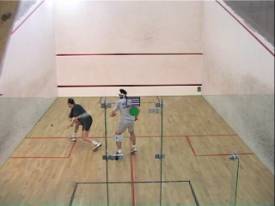
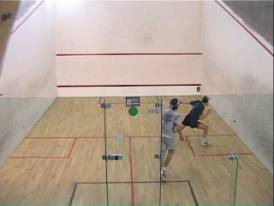
The scenario is described
here with the help of a series of video clips. The player in the dark shirt
is unable to send his ball deep into the back corners, and is being driven
behind by an opponent who is keen to volley and stay in front. |
|||
|
|
|||
|
Therefore, his first
objective must be to make sure his length is long enough to reach the back
wall. There is no point in believing to be playing a backcourt game when the
opponent consistently takes the ball around the service box area. The second
objective would be to make sure that his defensive shots adopted to slow the
pace, must be well directed to the back and not bounce out of the back
corners. The player could try to slow the pace down for a few rallies and
play a totally defensive game if he is not able to produce low penetrating
shots. The defensive game ( |
|||
|
|
|||
|
His third and most critical
objective would be to utilise every loose shot by the opponent, to respond
with an attacking powerful shot to the back-court.* This could well provoke
other loose shots by the opponent. At this stage, the player is chipping away
at the “wall”. |
|||
|
|
|||
|
|
|
|
|
|
In the two positions
demonstrated above, the player in the dark shirt has a perfect opportunity to
play a short shot and stretch the opponent to the front. However, as he has
not been predominantly in front, he should use such situations to hit
aggressive deep shots to confirm his position on the T. |
|||
|
|
|||
|
*One of the most common
errors made by a player in great difficulty, is to attempt the short winning
shot as soon as he gets half a chance. The dominating opponent will
undoubtedly be quick and respond well, as he has not yet been put under
pressure at the backcourt. Also, the short shot
may well go down into the tin, and the player will have lost the opportunity
to capitalise on the situation. Even if it turns out to be a winner once in a
while, the player has really not achieved much, because the next rally, he
will find himself again under the same pressure. |
|||
|
|
|||
|
With persistence and
determination, our player is more often on the T. Then, he gets the chance to
really stretch the opponent, and on the successive shot, manages to
out-position him. He gets him running and concludes the rally with a
winner. |
|||
|
|
|||
|
If the player continues to be
successful in staying in the middle |
|||
|
|
|||
|
Now step into the shoes of
the player who is following that famous coach’s advise in the previous
section entitled “Practical talk”. This time, events will not flow perfectly
as desired. The opponent has other plans.
Will the player be able to invert the
situation and make those walls crumble, or will our player who knows this
section on tactics like the back of his hand, find the answers to fend off
his rival? Try out this game for yourself. Imagine all the possible actions
the opponent could take to impede our player, and all the solutions,
extracted from the concepts explained above, that our player could adopt to
continue successfully with his plans. |
|||
|
|
|||
|
|
|||
|
|
|||
|
|
|||
Watching
|
|||
|
|
|||
|
Watching to learn, and
learning to watch, are two subjects that are interlinked and interesting to
explore. I remember as a young boy, the enthusiasm with which I would go on
court just after watching top players in action. I tried to learn and copy
their shots and every move on court. Observing expert players is always
stimulating. Such an experience usually makes us think of our own game and
what we could do to change and improve it. |
|||
|
|
|||
|
Watching our opponents in
action against other players is another experience that should not be
neglected. Observing calmly from outside the court has great advantages. Our
mind can be more focused on what the others are doing. This is not usually
possible when we are on court and participating in the action. Besides, an
external view of the whole court from a good angle can reveal certain
aspects, which would not be seen from within the court itself. This is not to
say that carefully noticing an opponent's actions from within the court is of
little significance. That too, is vital, for the development of sound
tactical play. The main difference is that when watching an opponent playing others,
we have more time to analyse the various situations and come up with a
strategy that would work well. |
|||
|
|
|||
|
More shall be said in a
moment about understanding an opponent's game better. For now, let us refer
our attention to the top professionals and see how we could learn from them. |
|||
|
|
|||
|
players |
|||
|
|
|||
|
Looking at these athletes
playing could be an infinite learning experience. The different playing
styles, physical and psychological characteristics, all add up to a mix of
ingredients, which in time, could demonstrate all there is to be learnt.
Their matches constitute the ultimate technical and tactical laboratory. |
|||
|
|
|||
|
There is no doubt that
watching to learn is therefore necessary. The important question is, how do
we learn to watch? In other words, seeing these players' brilliant
performances and being drawn into their spectacular play and competitiveness
is not the answer. What should we look out for? How can we concentrate on the
finer details? What are they really trying to do in order to win? These are
the questions that need to be answered. |
|||
|
|
|||
|
This is not always easy. Let
me try to explain. When we go to a big tournament to enjoy watching such
exciting players, we experience so much enjoyment as they compete, that we
are drawn into watching the ball. Our main interest becomes how accurately
the ball is sent here or there, and whether the players will reach it or not.
We may also become emotionally attached as we sense the pleasure of viewing
extraordinary talent, or if we prefer to see a particular player win. |
|||
|
|
|||
|
Analysing a player's game or
a match becomes very difficult. In order to learn the most, we should be able
to isolate the various components that make up the player or match, and at
the same time see the whole picture. Only the lucky ones who get the chance
to frequently see these exceptional athletes can afford such detached
observation. Besides, if we do watch squash analytically and come up with
some hypothesis, it only becomes interesting as we watch more matches to test
our ideas and have confirmation. |
|||
|
|
|||
|
The moral of the story is, we
either have to watch a huge number of matches or see as many videos as
possible (preferably of complete matches) over and over again. Each time we
look at one of these tapes, we should try to focus on particular details or
aspects. We should come up with a conclusion/s, then watch the same match
again to see if our ideas hold. Comparisons could also be drawn between
players and strategies in other matches. |
|||
|
|
|||
|
So, which details should we
look out for? Well, having read most of this book, you should not be short of
ideas. From a technical point of view, try to observe how the players swing
their racket and the slight differences in style, timing, and impact. Certain
players use the wrist more, while others use a longer swing and
follow-through. Try to see if one style produces more accurate shots than
another. Professional players have their speciality shots or favourite shots
too. Try to identify who has the best drop-shot or counter drop, boast, or
lob, just to name a few. Having done that, you may try to identify why that
is so. Which technical aspect favours a particular player to have more
accuracy when producing these shots? It would also be interesting to see
which player is most deceptive, and try to understand why. Compare his/her
methods to those described earlier. |
|||
|
|
|||
|
Their movement and footwork
should be observed in every possible situation. Identify the fastest and most
efficient of players. Is his/her speed due to purely superior physique, or do
they move perfectly and see the ball very early as explained in the specified
section in this book? Note each player's physical characteristics and see how
they make the best use of them. Some players are muscular and powerful, while
others are light and agile. Some are tall, while others are short. How do
their technical abilities and physical structure influence or shape the
tactical choices they make? |
|||
|
|
|||
|
This takes us to the real
battle on court. Which player can tactically prevail? Even though these
players are the best, they all have their relative strengths and weaknesses.
How do they make the most out of their strong points, and how does the
opponent react? Does he/she find a solution to defend or counterattack? At
the same time, try to determine which are the relative weaknesses of each
player and see if the opponent will take advantage and confirm your
impression. |
|||
|
|
|||
|
The personality and
psychology of these players should also be examined. It is always interesting
to see how the calm and confident are able to remain concentrated and win,
while the less stable are most likely to lose. The real pros know how to
handle every situation. They hardly lose control when interacting with either
the opponent or referee. |
|||
|
|
|||
|
There is much more to be
found about game psychology in the section below. (click here
if you wish to go there now) Before that, let us first have a look at
our opponents. |
|||
|
|
|||
|
opponents |
|||
|
|
|||
|
Watching an opponent while we
are playing is rather obvious, though important. As mentioned above, the
point here is to emphasise the importance of watching our opponents as they
play against others. In doing so, we have more time to reflect on what we
see, and can create a comprehensive idea of what he/she is capable of. We
should basically look for their strengths and weaknesses, in all the various
compartments. Having constructed a good picture, it is then possible to think
of a game plan that would provide the right defensive action against each
opponent's strengths and a clear idea of how to attack their weaknesses.
(click here to see the section "Knowing your
opponent") |
|||
|
|
|||
|
Another advantage to watching
our opponents against others, is that of seeing how different playing styles
interact, and gaining fresh ideas. Consider this common phenomena. You
usually win against player A, and mostly lose against player B, but player A
almost always beats player B. What could be the reason? |
|||
|
|
|||
|
The answer is simply that the
type of game that player A adopts creates the most problems for player B. To
be more exact, we should examine what is meant by "type of game".
Here, it implies that the shots used by player A, as a response to particular
shots produced by player B, are very effective. So, as you observe the two
playing against each other, try to individuate these shots and compare them
to how you would have responded. This exercise will help you know your game
better and acquire new ideas and/or skills.
|
|||
|
|
|||
|
Player A may also have
particular movement qualities that make all the difference. He may be
generally quicker than you or faster in certain key situations. He may also
last a little longer and is capable of sustaining each rally for more shots.
Again examining the physical aspect could provide you with clear indications
of where improvements could be made to your game, and how you should train. |
|||
|
|
|||
|
The cause of this strange
situation may also be psychological. Suffering more against one player
compared to another is common. The mind is our control centre. If things up
there do not run smoothly, all our actions are disturbed. The next section
talks about game psychology. |
|||
RETURN TO INDEX GO TO NEXT
SECTION